
Programme Management: The Potential of Programme Management to improve the delivery value of projects
A. J. Lumsden and J. Heathcote.
Centre for Project Management, School of the Built Environment
Leedsmet University, Leeds, LS2 8AJ
J.Heathcote@Leedsmet.ac.uk
Please cite as: Lumsden, A.J. and Heathcote, J. (2011) Programme Management: The Potential of Programme Management to improve the delivery value of projects, Online Journal of Project Management, Reviews, No. 4, 1st Quarter 2011
Abstract
Differences in the definition and application of programme management exist in practice. Amongst theorists and project management writers the definition and development of the ‘idea’ of programme management suggests that the potential advantage and the need for such a system is desirable, filling the important gap between project delivery, benefits and strategy implementation. This paper shows the potential that programme management holds for the improved successful delivery of projects and their relevance to the organisation’s strategic goals. Achieving effective programme management in practice might present implementation challenges. What is clear is that projects need to have a strategic perspective regardless of the presence of formal programme management, and successful projects focus on the ultimate benefits of the products they deliver, not simply the ‘products’ themselves.
Keywords – Projects; programme management; benefits; project management
1. INTRODUCTION
‘Programme management’ is the deliberate organisation of projects in the
organisation (or portfolio of work) to allow for a coordinated
delivery. That coordination seeks to add additional value/benefit by
aligning the projects in the programme with benefits that themselves
will bring about strategic change/improvement.
Promoted by the Organisation of Government Commerce in the U.K. and
various project management authors (Office of Government Commerce
(2007). Rayner, P. (2007). Lycett, M. Rassau, A. and Danson, J (2004).
Thiry, M (2002). ) as a method for the better delivery of projects, the
benefits they may bring and ultimately strategic change. Programme
management is seen by the Association for Project Management (2000) as
an important part of managing projects and perhaps a role in its own
right (OGC 2007).
Englund, Graham and Dinsmore (2003) suggest that managing projects through programmes is an effective way to implement strategy.
This paper examines the impact of programme management as a process of coordination of projects and its potential for impact on the success of the individual project.
2. METHODOLOGY
The aim of this paper is to discuss how:
programme management can contribute to the successful delivery of projects.
This will be done through the following objectives:
The paper utilises a desktop study to examine current literature on programme management.
3. LITERATURE REVIEW & ARGUMENT
The Office of Government Commerce (2007, p4) defined Programme Management as ‘the action of carrying out the coordinated organisation, direction and implementation of a dossier of projects and transformation activities to achieve outcomes and realise benefits of strategic importance to the business.’ The Project Management Institute (PMI, 2008, P10) defined Programme Management as ‘the centralised coordinated management of a program to achieve the program’s strategic objectives and benefits.’ It may be deduced from this that Programme Management involves the coordination of a number of projects, each of which play a part in delivering strategic benefits to the company or organisation. Much like a project can be broken down in a Work Breakdown Structure creating more manageable loads of work (Figure 1.1), a Programme may be broken down into Projects, which can then be broken down to more manageable loads, such as work packages (See Figure 1.2).
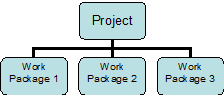
Figure 1.1
Project Structure
Lumsden (2010)
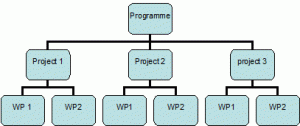
Figure 1.2
Programme Structure
Lumsden (2010)
Lycett et al (2004, P289-299) stated that ‘programme management is in effect a scaled-up version of project management’. Considering the structure of Figure 1.1 and Figure 1.2, it could be argued that Programme Management adds a new level to Project Management, or is a ‘scaled up version of project management’; and just as the breakdown of a project may be strategically executed to deliver a solution, the strategic alignment of a programme of projects may serve the same purpose. Maylor et al (2006, P663-674) questioned the definition of ‘project’ work, ‘are there now any boundaries to what constitutes project work, and does it matter?’ this may suggest that a programme of projects could still be considered a project in itself. Research suggested differences between programme and project management will be discussed throughout this essay.
Project success may be measured primarily by time, cost and quality; however Papke-Shields et al (2009, p4) suggested that ‘there has been general agreement that project performance goes beyond these [time, cost and quality] aspects’. They went on to discuss that ‘important dimensions in project success include customer satisfaction and/or business success.’ This may suggest that the actual benefits which the project delivers may be equally, if not more important than time, cost and quality or the delivery.
Thiry (2002, P221-227) discussed various definitions of Programme Management (APM, PMI and OGC) and concluded ‘the main common points are that programmes usually cover a group of projects; that their management must be coordinated; and that they create a synergy, which will generate greater benefits than projects could do individually.’ Structuring projects in programmes of work may provide the company a greater benefit than a project delivered individually, this may be for one of several reasons.
If it is the benefits the project provides the organisation which determine its success, it could be suggested that a project may fail before it has begun; as Kemp (2004, p77) suggested ‘a good idea can be a bad project.’ If a project has a budget approved and the Project Manager begins planning their resource allocation before understanding what the benefit to the organisation is going to be, the project could be delivered on time, on budget, to quality expectations, but have no benefit and thus be seen as a failure. This may be due to a number of reasons, including undefined success criteria, or a weak or no business case for the project. Reyner (2007, P6) suggested that ‘Indeed, there are many projects that have been deemed highly successful that have created deliverables that have never actually been used.’ Obeng (1996, p2) discussed that ‘A project must only be undertaken to solve a problem.’, which suggests that a project must have a clear purpose, success criteria and set benefits to even have a chance of being successful. Programmes are a ‘synergy’ of projects (Thiry, 2002, P221-227), which together ‘achieve outcomes and realise benefits of strategic importance to the business’ (OGC, 2007, P4); it may be suggested that even before they begin, projects in a programme of work stand a better chance of ‘success’ in terms of benefits delivered than those not in a programme of work; as they may be more likely to have a strategic benefit to the company. Lycett et al (2004, p289-299) suggested that ‘programme management provides a means to bridge the gap between project delivery and organisational strategy.’ Even if the project provides no direct financial benefit, it may be delivered as part of a larger piece of work, such as a piece to a puzzle, hence in the bigger picture it is providing benefit to the company.
The concept of delivering strategic benefit to a company was discussed by the Office of Government Commerce (2007, P4), ‘Programmes deal with outcomes; projects deal with outputs.’ Similarly, Thiry (2004, p245-252), stated that in programme management ‘the focus is on the organisation rather than the team and instead of talking about deliverables, one talks about benefits.’ In doing this, it could be argued that Kemp’s suggestion (2004, p77) that ‘a good idea can be a bad project’ can be safeguarded against through programme management; the project manager will ensure the project deliverables are met, whilst it is the programme manager’s role to ensure that the project deliverables will deliver strategic benefit to the company; although communication between the two may be necessary, as a separation could effect both programme and project delivery.
It could be argued that all projects start with an idea, and so it could also be argued that Kemp’s suggestion (2004, p77) ‘a good idea can be a bad project’ may have began in the Initiation or Concept phase. Thiry (2004, p245-252) discussed the benefits of the programme management lifecycle, and their differences from the project management lifecycle. Thiry suggested that the Initiation phase of programmes ‘is the stage where purpose is defined, stakeholders, their needs and expectations are identified; it is also the stage where programme benefits are determined.’ This may immediately rule out ‘good ideas’ which are ‘bad projects’, as a lack of benefit would be identified at this stage.
As programmes may generally include a group of projects, it may be important for the business to distinguish an order of priority for these projects. Martinsuo and Lehtonen (2007, p56-65) defined portfolio management as ‘a group of projects that share and compete for the same resources and are carried out under the sponsorship or management of an organisation’. The concept of a portfolio of projects may have similarities with a programme of projects, as both involve more than one project, both may share the same resources, and both fall under an ‘umbrella’, such as the sponsorship or business owner. The main difference may be that a programme of projects is linked through a common strategic objective, whereas for a portfolio of projects, this may not be the case. To reach this common strategic objective, both programmes and projects are prioritised according to the desired strategy. The APM (Association for Project Management) discuss a ‘natural sequence’ (Reyner, n.d, p1) which most programmes will follow;

Figure 1.3
Rayner, P.
(n.d, P1)
As suggested by Figure 1.3, the first stage of the process is to define the desired strategy; after this, prioritisation takes place. Through programme management it could be argued that the company, or owners of the programme, are encouraged to prioritise and decide upon which projects are going to deliver their defined strategy. In challenging economic times such as recession, it may not be uncommon for organisations to make cuts across their portfolio of projects due to limited funding. Despite limited funding, these organisations may still seek to get the most possible benefit from their investment in projects. Referring to Figure 1.2, it was suggested that programme management may be seen as a ‘scaled-up version of project management’ (Lycett et al 2004, P289-299); following this it may be the case that the projects involved in a programme of work have logic assigned to them, and hence forth a critical path. In the case of an organisation having to cancel projects, knowledge of this critical path may be invaluable; the organisation, or programme manager may be able to select a project to be put on hold or cancelled which does not lie on the critical path. Without this knowledge a common misconception may be made that the most expensive projects are the most valuable, and thus the projects of lesser monetary value may be cancelled. This could lead to a small value, but critical project threatening the overall strategically benefit of the programme. Through programme management and the process of prioritising their strategic goals, organisations can look at a ‘bigger picture’ of their work, and recognise which projects are most critical to delivering strategic benefit.
Arguably projects in a programme of work are contributing to strategic organisational benefit on some level; however through prioritisation of the projects the organisation may come to realise that not all projects are actually as beneficial as they are conceived to be. Pareto’s 80/20 theory (Haughy, n/d) suggested that ‘by doing 20% of the work [you are currently doing] you can generate 80% of the benefit of doing the whole job.’ Pareto’s theory highlights the possibility of inefficiency in organisations work; and through this method of prioritisation in programmes of work, this may be recognised and rectified, improving the efficiency of project delivery.
As well as assisting in identifying the benefits of projects, and their prioritisation, programme management may also assist the delivery through available resources. A portfolio of projects ‘share and compete for the same resources’ (Martinusuo and Lehtonen, 2007, p56-65); following this Reiss et al (quoted in Shehu, Z. and Akintoye, M. 2009, p703-716) defined programme management as ‘the management of a portfolio of projects which call upon the same resources, and concentrates on the next stage of development.’. This establishes that projects ‘can’ call upon the same resources, this option in itself may be a benefit to a project; furthermore, if this option is available on a programme of projects, in the initiation stages of the individual projects, resources may already have an idea of the purpose or mission of the work to be completed, saving an explanation from the project manager; this may be a benefit when identifying risks and dependencies with other projects. If resources are to be shared across a portfolio of projects, they may have a given knowledge of the purpose or mission of the set of projects, having already worked in their context. Shehu and Akintoye (2009, p703-716) discussed ‘programmes can benefit immensely from sharing the same resources on the projects. This will help to improve the accuracy and efficiency of executing the projects, as the same resources are already aware of the mission and the nature of the projects being delivered.’
As well as having an understanding of purpose may make resources more readily available to alternate between projects in a programme of work, it may also be argued that and understanding of purpose acts as a motivational influence of team members performance. Humphries (1998, P40) suggested that ‘It is essential that every member of the team knows and understands the purpose and objectives.’ Kahn and Kahn (1991, quoted in Gorse 2003) suggested that ‘Goal setting’ and ‘Perceived goal specificity’ were directly linked to goal commitment in a team working situation. Similarly, Mourkogiannis (2006, P112) suggested that ‘An organisation with a strong sense of Purpose does not just make people feel better. It also creates a strong sense of direction and obligation. Indeed it raises morale at least party because it creates this sense of direction.’ He went on to discuss that ‘This combination of energy and direction makes it effective at stimulating action.’ This may suggest that through sharing resources on a programme of projects, and training them to be aware of what the purpose of their role is in a larger picture, may lead to resources performing more efficiently. A result of naturally motivated resources on a project could contribute to its successful delivery.
4. CONCLUSIONS
In conclusion, programme management may be seen as a ‘scaled-up version of project management’, as suggested by Lycett et al (2004, P289-299), or it may be argued that programme management goes a lot further than this, and that as Shehu and Akintoye stated (2009, P703-716) ‘programme management is not the same as project management, but rather an integrated approach that can streamline the effective delivery of projects.’. There appears to be ambiguity in the available definitions of programme management, however it does seem clear that it does offer benefits to the delivery of projects. It may be accepted that project success is measured by time, cost and quality, and also the business benefit or strategic benefit the project actually delivers. It may be widely accepted that the aim of programme management is on a strategic level, and that any project in a programme of work will play a part in some form of strategical benefit for a company or organisation; as stated by Thiry (2004, P245-352) ‘[In programme management] the focus is on the organisation rather than the team and instead of talking about deliverables, one talks about benefits.’ Through the programme manager dedicating this attention to the benefits of the delivery, if the project manager can achieve the specific deliverables within the given time, cost and quality requirements, then the project may been seen as more of a success; it has been delivered to its expectations, and is also providing strategic benefit to the company; it is the programme management which delivers strategic benefit by coordinating the benefits delivered by individual projects.
More specific benefits of programme management on the delivery of projects may be that it encourages the company to prioritise their projects; in doing so this means an understanding of their projects may be developed as to where their priorities lie. This may assist in ensuring that the company is actually delivering the right projects from them, at the right time; this may also highlight projects which may not be the most beneficial to the company or organisation, as suggested by Pareto’s 20/80 theory (Haughy, n/d). Programme management also allows the sharing of resources across projects; through exposing resources to a number of projects, they ‘are already aware of the mission and the nature of the projects being delivered’ (Shehu and Akintoye, 2009, P703-716), arguably making them more valuable to the project. As discussed by Mourkogiannis (2006, P112) a sense and awareness of the purpose of work may actually motivate resources and improve their efficiency. Naturally motivated resources may contribute to more successful delivery of projects.
As stated by Obeng (1996, p2) ‘A project must only be undertaken to solve a problem.’; this may mean that to deliver a successful project, it must solve a problem. As suggested by Van Heuveln (2000, P63), ‘defining the problem is half the solution’. By delivering a project as part of a programme of work it is part of a larger strategic work load designed to deliver strategic benefit, meaning the project is solving a problem, which has been defined at a higher level than project management. As stated by Richard Hamming (Quoted in Petersen, 2003, P435), ‘It is better to do the right problem the wrong way, than the wrong problem the right way.’ A project in a programme has a set purpose and benefit associated with it, meaning that if it has the ‘right problem’ to answer, it will be one which will benefit the company. It may be the case that projects outside a programme of work are also in this situation, but programmes of work are developed for this reason, to ‘achieve outcomes and realize benefits that are of strategic importance’ (OGC, 2007, P4).
5. REFERENCES
Englund, R. Graham, R. Dinsmore, P. (2003) “Creating the project office: A manager’s guide to leading organizational change” Jossey-Bass
Haughey, D (PMP) Pareto Analysis Step by Step n/d. [Internet] Avaliable from:
Humphries, J. (1998) Managing Successful Teams: How to achieve your objectives by working effectively with others. How to books, Oxford, United Kingdom.
Kemp, S. (2004) Project Management Demystified. McGraw-Hill Professional, Two Penn Plaza, New York.
Lycett, M. Rassau, A. and Danson, J (2004) Programme management: a
critical review. International Journal of Project Management [Internet]
22 (4) May, P289-299. Available from
Martinsuo, M and Lehtonen, P (2007) Role of single-project management
in achieving portfolio management efficiency International Journal of
Project Management [Internet] 25 (1) January, P56-65. Available from:
Maylor, H. Brady, T. Cooke-Davies, T. Hodgson, D. (2006) From
projectification to programmification. International Journal of Project
Management [Internet] 24 (8) November, P663-674. Available from:
Mourkogiannis, N. (2006) Purpose: The Starting Point of all Great Companies. Macmillan Publishers Limited, Basingstoke, Hampshire, England.
Obeng, E. (1996) All Change! Pearson Education Limited, Edinburugh Gate, Harlow.
Office of Government Commerce (2007). Managing Successful Programmes, The Stationary Office, Norwich, England.
Papke-Shields, K. E, Beise, C & Quan, J. (2009) Do project
managers practice what they preach, and does it matter to project
success? International Journal of Project Management. [Internet] In
press, corrected proof. December. Available from:
Petersen, J (2003) Fiber Optics Illustrated Dictionary. CRC Press, Corporate Blvd, Boca Raton, Florida.
Project Management Institute (PMI), (2008) a guide to the Project Management Body Of Knowledge (PMBOK Guide) 4th ed. Project Management Institute, Newton Square, Pannsylvania.
Rayner, P. (2007). APM Introduction to Programme Management. [Internet] (1) Available from:
Rayner, P. (nd). APM Specific Interest Group: Programme Management [Factsheet]. [Internet] (1) Available from:
Shehu, Z. and Akintoye, A. (2009) Construction programme management
theory and practice: Contextual and pragmatic approach. International
Journal of Project Management. [Internet] 27 (7) October, P703-716.
Available from:
Thiry, M (2002) Combining value and project management into an
effective programme management model. International Journal of Project
Management [Internet] 20 (3) April, P221-227. Available from
Thiry, M (2004) “For DAD”: a programme management life-cycle process.
International Journal of Project Management [Internet] 22 (3) April,
P245-252. Available from
Van Heuveln, B. (2000) Emergence and Conciousness: Explorations into the Philosophy of Mind via the Philosophy of Computation. Binghamton University, State University of New York.